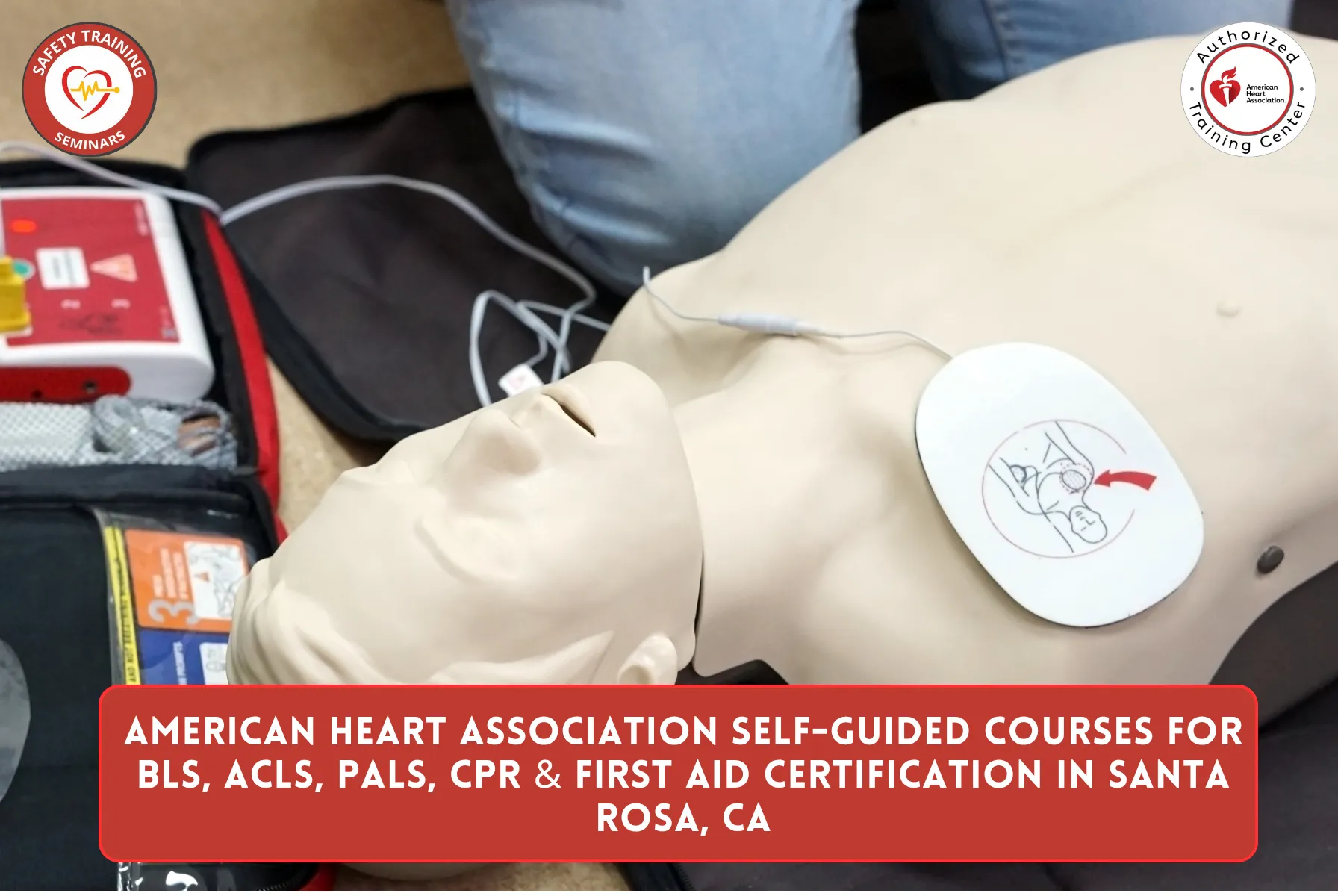
As the health care and services hub for Sonoma County, Santa Rosa draws working professionals from across the North Bay who need current certification but can’t always give up a full day for a class. American Heart Association (AHA) Self-Guided Learning fits that reality. It divides a course into an online knowledge portion you complete at your own pace and a hands-on skills portion you finish in person, so the only fixed appointment is a short one. This article explains how the format works for BLS, ACLS, PALS, CPR, AED, and First Aid, who each course is for, and how someone in Santa Rosa, California can settle on the right one before enrolling.
Key takeaway: AHA Self-Guided Learning combines self-paced online coursework with the in-person skills check that provider certifications require — flexible timing without losing the hands-on component. The course you need follows your role and the rules of your employer, school, or licensing body, so confirm that first.
How AHA Self-Guided Learning Works
The format runs in two parts. You complete the cognitive portion first, a self-paced online module. For provider-level courses, a hands-on skills session follows in person on equipment that gives real-time feedback — often at an AHA CPR Verification Station learning center. The certification issues only after the skills portion, which separates this route from a course delivered entirely online.
Typical steps:
- Choose the course tied to your role or requirement.
- Work through the online knowledge module on your schedule.
- Attend the in-person skills session and pass the skills check (provider courses).
- Receive your course completion card or provider eCard.
The Courses You Can Complete This Way
Basic Life Support (BLS)
BLS is the credential behind most clinical work in the county’s hospitals and clinics, requested by surgical and patient-care technicians, nurses, paramedics, medical assistants, dental staff, and health-program students. It moves past public CPR into team resuscitation, airway management, and high-quality compressions for every age. Because the requirement isn’t identical across roles, verify what your employer or program expects. Many local staff begin with BLS and CPR classes in Santa Rosa.
Advanced Cardiovascular Life Support (ACLS)
ACLS is for clinicians who help manage adult cardiovascular emergencies — emergency and critical-care nurses, physicians, and paramedics among them. It builds on BLS with rhythm interpretation, medications, and resuscitation-team leadership. Because a busy regional hospital system keeps many providers current, ACLS renewals are common here; whether you need it depends on your specialty and workplace, so treat it as role-specific.
Pediatric Advanced Life Support (PALS)
PALS focuses on emergencies in infants and children, for providers who treat younger patients such as pediatric and emergency nurses. Like the other provider courses, it pairs independent study with an in-person skills session. Since pediatric care has its own protocols, PALS is a separate certification — confirm whether it’s on your list if children are part of your caseload.
CPR, AED, and First Aid
Away from the clinical setting, plenty of people in Santa Rosa need training too. Hospitality and winery staff, teachers, childcare workers, coaches, fitness instructors, and family caregivers often complete CPR/AED or First Aid to meet a workplace policy or to be ready at home. These courses cover compressions, rescue breathing, AED use, and everyday injury care, no clinical background assumed. Because employers accept different versions, ask which course and card yours requires first.
Choosing the Course That Fits
The wrong class means doing it over, so match the course to your role from the start:
| Course | Typical audience |
| BLS | Healthcare professionals and clinical students |
| ACLS | Clinicians managing adult cardiac emergencies |
| PALS | Clinicians managing pediatric emergencies |
| CPR/AED | General public and workplace staff |
| First Aid | Schools, childcare, workplaces, community members |
Use it as a guide, not a rule. Your requirement can depend on your employer, school, licensing board, or healthcare organization, so confirm the course and accepted format before you pay. When unsure, whoever requests your certification can tell you which to complete.
Self-Guided, Classroom, and Online-Only
The three aren’t interchangeable:
- Self-Guided Learning joins independent online study with an in-person skills session for provider courses — flexible pacing, with skills still shown in person.
- Traditional classroom training delivers everything in one scheduled, instructor-led session, for people who prefer a teacher present.
- Online-only training is fully on-screen. It may suit some awareness-level needs, but often won’t meet a requirement that includes a hands-on skills check — standard for provider certifications.
No format is best for everyone; the right one depends on your schedule, how you learn, and what your certifying body accepts.
What the Format Offers Santa Rosa Learners
Because Santa Rosa serves the whole county, many learners balance work with a drive in from a surrounding town. A nurse renewing between shifts, a clinical student at the local college, a winery or restaurant employee arranging staff training, or a resident coming from Rohnert Park, Windsor, or Sebastopol can each finish the online portion whenever time allows and reserve one downtown visit for the skills session. Renewals move quickly once the material is familiar, and workplaces can keep a team current by staggering the online work. Providers on an advanced path can review the ACLS and PALS class options in Santa Rosa to see how the self-guided route works.
Safety Training Seminars in Santa Rosa
For learners looking at a local option, Safety Training Seminars runs a downtown Santa Rosa training center at 825 College Avenue, Suite 3, Santa Rosa, CA 95404. As you consider it, focus on what shapes your certification: the course you need, whether it includes the hands-on skills your role requires, and the card or eCard you’ll receive. Confirm the course format and that the documentation will be accepted by your employer or school before registering.
Why Consider Safety Training Seminars in Santa Rosa
A few points are worth weighing as you decide where to train:
- AHA-based courses with real hands-on skills. The Self-Guided format keeps the in-person skills verification provider certifications call for, not a screen-only shortcut.
- A central North Bay location. A downtown Santa Rosa center is reachable for locals and for people coming from Petaluma, Rohnert Park, Windsor, and Healdsburg.
- Course choice that follows your role. Sorting BLS from ACLS, PALS, CPR/AED, and First Aid is easier when the focus stays on your requirement.
- Documentation you can verify. You finish with a completion card or provider eCard you can check against what your employer or school expects.
Confirming your requirement always comes first — but once you know it, a nearby option that fits is worth a look.
Frequently Asked Questions
Which AHA courses can be completed through Self-Guided Learning? Self-Guided Learning covers the provider courses — BLS, ACLS, and PALS. You complete the cognitive coursework on your own, then finish an in-person skills session for the certification. The courses differ in content and audience, so choose the one that matches your clinical role and confirm the specifics first.
I’d drive in from another Sonoma County town — can I do the online part first? Yes. The usual order is to finish the cognitive module before your in-person skills session, so the reading is done at home and only the short skills visit is in Santa Rosa. For people coming from Petaluma, Windsor, or Sebastopol, that keeps the trip brief. Confirm the exact steps with the provider for your course.
My workplace wants staff certified — how does that work? Start by asking which course and card your employer requires, since CPR/AED and First Aid come in different versions. With that settled, the Self-Guided format lets employees complete the online portion on their own schedules and come in for the skills session — which makes coordinating a team simpler.
Can someone from a nearby city use the Santa Rosa center? Yes. Learners from Rohnert Park, Petaluma, Windsor, Sebastopol, Healdsburg, and other nearby communities can train at a Santa Rosa location, a hub for the county. Confirm course availability and scheduling before you go.
Is an online-only certificate enough for a clinical role? Usually not. Many provider positions require a hands-on skills check a fully online course can’t provide. If your role calls for BLS, ACLS, or PALS, verify whether an online-only certificate is accepted — in most clinical settings it isn’t sufficient on its own.
Where to Start
The distinction to remember is simple: Self-Guided Learning keeps the hands-on skills many certifications require, while an online-only course may not. Before registering anywhere in Santa Rosa, confirm which course your employer, school, or licensing organization requires, then check that the format you pick covers those in-person skills. With that settled, comparing what Safety Training Seminars offers locally — and matching it to your role and schedule — makes the last step easy.