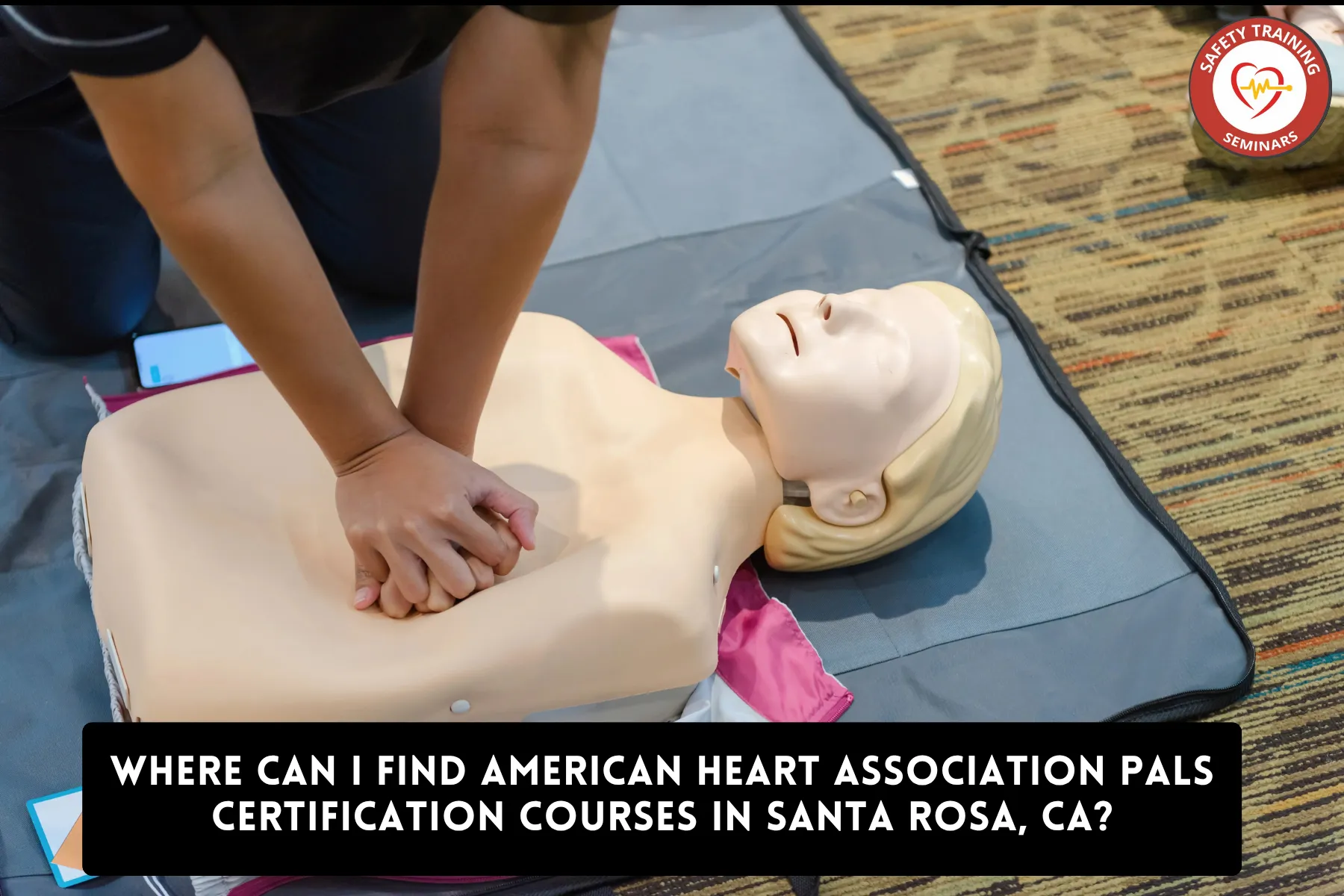
If you need an American Heart Association PALS certification course in Santa Rosa, one local option is Safety Training Seminars’ downtown training center on College Avenue. The center offers the AHA’s HeartCode® PALS blended format: you complete the online coursework on your own schedule, then finish with a hands-on skills session in Santa Rosa. Students who pass receive an official AHA PALS Provider eCard, which the business says is issued the same day.
Below is what PALS involves, who in Sonoma County typically needs it, how the blended format works, and what to check before you book a PALS class in Santa Rosa.
What PALS Certification Covers
Pediatric Advanced Life Support (PALS) is an American Heart Association course for healthcare providers who respond to critically ill or injured infants and children. It builds on Basic Life Support (BLS) and focuses on the period before and during a pediatric cardiac arrest, when early recognition can change the outcome.
A PALS Provider course generally covers:
- A systematic approach to pediatric assessment
- Recognizing and managing respiratory distress and respiratory failure
- Identifying and treating different types of shock
- Pediatric arrhythmias and cardiac arrest algorithms
- High-quality child and infant CPR, including team-based resuscitation
- Airway management and ventilation support
- Communication and role assignments within a resuscitation team
PALS is different from a basic pediatric CPR and first aid class. Childcare workers and parents usually take a community CPR course. PALS is built for clinicians who may need to make treatment decisions during a pediatric emergency.
Why Pediatric Readiness Matters in Santa Rosa Right Now
Santa Rosa is the medical hub of Sonoma County. Its three main hospitals are Providence Santa Rosa Memorial Hospital, Kaiser Permanente Santa Rosa Medical Center, and Sutter Santa Rosa Regional Hospital. Santa Rosa Memorial is also the only Level II trauma center serving Sonoma, Marin, Mendocino, and Napa counties.
Local pediatric care has also changed recently. Providence announced that inpatient pediatric care at Santa Rosa Memorial would end on March 27, 2026, while 24-hour emergency services for children would continue. Sick and injured children in the region still arrive at local emergency departments, urgent care clinics, and ambulances, but fewer local settings now specialize only in children.
In practice, more general emergency, urgent care, and EMS staff may be the first clinicians to stabilize a child before admission or transfer. Those settings handle pediatric patients less often than a dedicated children’s unit. Keeping PALS current is one way providers stay prepared for cases they may see only a few times a year.
Who Typically Needs a PALS Class in Santa Rosa
Requirements depend on the employer, the department, and the role. Professionals who are commonly asked to hold PALS include:
- Emergency department physicians, nurses, and technicians
- Paramedics and EMTs working on 911 or interfacility transport crews
- Respiratory therapists
- Nurses in pediatric, neonatal, labor and delivery, or critical care settings
- Urgent care providers and staff
- Anesthesia and procedural sedation teams
- Family practice and pediatric clinic clinicians
If you are unsure whether your position requires PALS, check with your manager, education department, or credentialing office first. Some employers specifically require AHA certification. Others also accept other providers, and some require PALS only for certain units.
How the HeartCode PALS Blended Format Works
Safety Training Seminars lists its Santa Rosa PALS course as an “online and skills” program built on the AHA’s HeartCode PALS format. The process has two parts.
Part 1: Online coursework
You complete the AHA’s online learning module wherever and whenever it suits you. The provider estimates two to three hours for this portion. It includes interactive patient cases and the cognitive content the AHA requires. For busy clinicians, this means you can study after a shift or across several short sessions instead of giving up a full day to a classroom.
Part 2: Hands-on skills verification
After the online portion, you schedule an in-person skills session at the downtown Santa Rosa location. The business lists this session at about 30 minutes. It uses a CPR Verification Station™, a feedback-driven system that measures compression and ventilation performance against AHA standards and lets learners repeat skills until they reach the required level.
Part 3: Your AHA eCard
After both parts are completed successfully, you receive the American Heart Association PALS Provider Course Completion eCard. AHA PALS cards are typically valid for two years, so mark your renewal date as soon as you receive it.
The Downtown Santa Rosa Training Center
Safety Training Seminars runs its Santa Rosa – Downtown CPR Training Center at 825 College Avenue, Suite 3, Santa Rosa, CA 95404. According to the business, it sits near the intersection of College Avenue and 9th Street, just north of the downtown core, with access from Highway 101.
The center serves students from Santa Rosa and nearby communities such as Rohnert Park, Petaluma, Windsor, Sebastopol, and Cotati. Its listed hours are 8 a.m. to 10 p.m., seven days a week. Those extended hours can help clinicians who work 12-hour shifts or rotating schedules fit a skills check around their work.
Course dates, current pricing, and registration are on the PALS certification course page for Santa Rosa Downtown. At the time of writing, the provider listed its PALS course at $290 with a low-price guarantee and sometimes runs promotional codes. Prices and promotions change, so confirm the current figure before you register.
The same location also offers AHA BLS and ACLS, AAP’s NRP, and CPR and first aid courses. If you need to renew BLS alongside PALS, you can browse the full course list on the Safety Training Seminars Santa Rosa CPR and BLS training site.
What to Check Before You Register
A little preparation keeps the process smooth and makes sure the certification you earn is the one your employer will accept.
- Confirm the certifying body. If your employer requires American Heart Association PALS, make sure the course issues an official AHA PALS Provider eCard.
- Know whether you need initial or renewal training. Many providers offer both. HeartCode PALS can serve both first-time and returning learners, but check your employer’s policy if your card has already expired.
- Have a current BLS certification. The AHA expects PALS students to be proficient in BLS, and many employers require a valid BLS card alongside PALS.
- Complete the precourse work. The AHA PALS course includes a precourse self-assessment. Reviewing pediatric ECG rhythms and pharmacology beforehand can make the online module much easier.
- Finish the online portion before your skills appointment. Bring your online completion certificate if the training center asks for it.
- Ask about group options. Hospitals, clinics, and EMS agencies sometimes arrange group sessions so an entire team can certify on the same schedule.
Frequently Asked Questions
How long does it take to get PALS certified through the blended format?
Most learners finish in a single day of total effort. Safety Training Seminars estimates two to three hours for the HeartCode online module and about 30 minutes for the in-person skills session in Santa Rosa. Your pace will depend on how familiar you already are with pediatric algorithms.
Is an online-only PALS course acceptable?
Usually not, if your employer requires AHA certification. The American Heart Association requires a hands-on skills component for its PALS Provider card. Online-only programs that skip in-person skills testing do not issue an AHA card and are often rejected by hospitals.
How often do I need to renew PALS?
AHA PALS certification is generally valid for two years. Plan your renewal before the expiration date on your eCard, since some employers do not allow any lapse in certification.
Do I need PALS if I work in adult emergency medicine?
It depends on your employer. Many emergency departments require PALS for physicians, nurses, and technicians because children can arrive at any ED. With fewer dedicated inpatient pediatric beds in Santa Rosa, general emergency staff may play a larger role in stabilizing young patients.
What is the difference between PALS and NRP?
PALS covers infants and children beyond the immediate newborn period. NRP, the Neonatal Resuscitation Program from the American Academy of Pediatrics, focuses on resuscitating newborns at and shortly after delivery. Labor and delivery and NICU staff often need both, so check your unit’s requirements.
Can I complete the skills check on a weekend?
The downtown Santa Rosa center lists hours of 8 a.m. to 10 p.m. every day. Check the registration page for open skills sessions, since availability varies by date.
Getting Started With PALS in Santa Rosa
For Sonoma County clinicians, the most practical route to AHA PALS certification is a blended course: online learning on your own time, followed by a short skills session close to where you live or work. Safety Training Seminars offers that format at its downtown Santa Rosa center, with daily hours and a same-day eCard for students who complete the requirements.
Before booking, confirm your employer’s certification requirements, make sure your BLS card is current, and set aside a few hours for the online module. When you’re ready, review upcoming dates and enroll through the Santa Rosa Downtown PALS course page, or call the training center at (707) 387-0903 with questions about scheduling.